

How Do You Reduce Kitchen Counter Clutter With Small Organizers?
Last Updated: November 8, 2026
Quick Summary
Reduce counter clutter with small organizers by first decluttering: sort items into daily, weekly and rarely used piles, and keep only daily items on the counter. Then match each organizer to its clutter category, such as a shallow tray for oils or a caddy for utensils, and keep organizers to no more than one-third of any counter run.
- Measure counter width, depth and cabinet clearance before buying any organizer.
- Keep organizers to one-third or less of an uninterrupted counter run.
- Limit counters under 1.5m to two zones plus the sink area.
- Use a closed container for cables, since visible cords read as clutter.
- Start with one counter, one zone and one organizer, then add more after a week.
Table of Contents
- Why Counter Clutter Builds Up (and What to Remove First)
- Small Kitchen Counter Organization Ideas That Actually Fit Limited Space
- Kitchen Countertop Storage Ideas: Trays, Caddies, Turntables and Risers
- Decorative Kitchen Countertop Storage That You Won't Want to Hide
- When a Kitchen Countertop Storage Cabinet Makes Sense in a Small Kitchen
- Pick Your First Small Organizer and Start With One Counter
- Frequently Asked Questions
Why Counter Clutter Builds Up (and What to Remove First)
Counter clutter is what happens when a flat surface becomes a holding zone instead of a workspace. Every object that lands there, from keys to unopened mail to the rice cooker, stays because nobody gave it a home.
The fix starts before you buy anything. Most people shop for organizers first, then discover they are just storing things they never needed on the counter.
The quick declutter pass before you buy a single organizer
Walk your counter and sort every item into three piles:
- Daily use: coffee maker, kettle, knife block, soap
- Weekly use: stand mixer, blender, spice jars
- Rarely used: bread maker, extra mugs, holiday dishes
Move the weekly and rarely used piles into cabinets or a pantry. Only the daily pile earns counter space. For a calmer, room-by-room approach to the same process, our guide on how to organize your home for efficiency without the overwhelm walks through it step by step.
Watch out: skipping this pass is the most common mistake. People buy a caddy, fill it with clutter, and the counter looks messier than before.
Small Kitchen Counter Organization Ideas That Actually Fit Limited Space
Small kitchen counter organization ideas work best when they match your counter's real dimensions, not a Pinterest photo. Before you buy anything, measure three things: the free counter run (width), the usable depth from backsplash to edge, and the clearance under upper cabinets.
A simple rule: keep organizers to no more than one-third of any uninterrupted counter run. If you have 90cm between the sink and the stove, your organizers should occupy 30cm or less, leaving 60cm for prep.
Match the organizer to the clutter category
Generic advice says "use trays and caddies." Practical advice says match the organizer to what actually piles up. Here are five common clutter categories and the small-organizer setup that contains each one without crowding the counter:
- Mail and paper: A single shallow tray or a vertical file holder placed at the drop zone. Keep it to one tray, a second tray becomes a second pile. Sort it weekly, not daily.
- Cooking oils and seasonings: A shallow tray with a lip, kept beside the stove but at least 15cm from the burners. The tray catches drips and lifts off as one unit to wipe the counter. Avoid open crocks near the stove; grease film builds up fast.
- Utensils: A caddy with divided compartments, placed within arm's reach of the cutting board. If your counter run is under 60cm, use a freestanding utensil holder that sits against the backsplash rather than a wide crock.
- Coffee supplies: A dedicated tray or a small turntable that holds pods, sugar, and a spoon. Keep it on the far side of the coffee maker from the prep zone so the two tasks do not compete for the same 30cm.
- Charging devices and cables: A small lidded box or a cable-management tray with a notch for the cord. This is the one category where a closed container beats an open tray, because visible cables read as clutter even when they are organized.
Use zones, but size them to your counter
Each zone gets one job: a coffee zone holds the kettle, mugs, and pods; a prep zone stays clear except for a cutting board and knife; a drop zone near the door catches keys and mail.
Watch out: measuring only the width of your counter and ignoring depth and clearance is the most common reason a new organizer ends up returned. Measure all three before you buy.
Kitchen Countertop Storage Ideas: Trays, Caddies, Turntables and Risers
The best kitchen countertop storage ideas use four workhorses: trays, caddies, turntables, and risers. Each solves a different clutter problem.
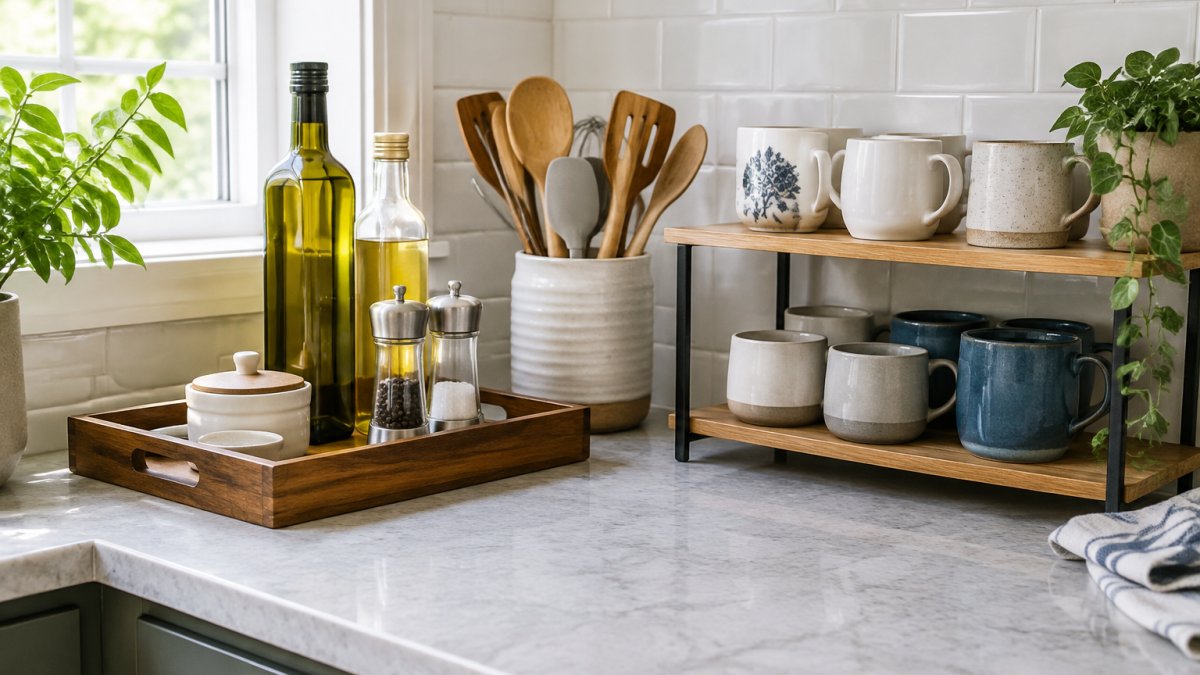
Match the organizer to the clutter:
| Clutter type | Best organizer | Why it works |
|---|---|---|
| Oil bottles, salt, pepper | Shallow tray | Contains drips, lifts as one unit to clean |
| Utensils, spatulas | Caddy | Keeps handles upright and reachable |
| Spices, condiments | Turntable | Spins back items to the front |
| Mugs, small bowls | Shelf riser | Doubles usable height |
For tea bags and trinkets, a compact ceramic jar keeps small items contained without adding visual noise. Our Nordic Gold Bird ceramic storage jar is a multipurpose trinket box and tea bag organizer with a porcelain body and gold-accented lid.

Decorative Kitchen Countertop Storage That You Won't Want to Hide
Decorative kitchen countertop storage solves a problem most organizers ignore: if a box is ugly, you hide it, and hiding defeats the purpose. Choose pieces you are happy to see.
Good options include ceramic jars, wooden trays, woven baskets, and stoneware caddies. They hold the same items as plastic bins but read as decor.
Watch out: decorative pieces still need cleaning. Wipe trays weekly, and empty jars before crumbs build up.
When a Kitchen Countertop Storage Cabinet Makes Sense in a Small Kitchen
A kitchen countertop storage cabinet earns its footprint only when you have vertical space and no closet nearby. These small cabinets sit on the counter and add shelves above it, holding appliances or pantry staples. They suit renters who cannot drill into walls.
Skip a countertop cabinet if your counter is already shallow. It will crowd your prep area. A shelf riser gives similar height without the bulk.
Rental-friendly and no-drill vertical storage options
If you rent or cannot make permanent changes, you still have several ways to add vertical storage without a single screw. The trade-off is stability and load capacity: no-drill options hold less weight than wall-mounted shelves, so reserve them for light items.
- Tension-pole shelving: A spring-loaded pole with adjustable shelves fits between the counter and the underside of upper cabinets. It holds mugs, small bowls, and spice jars but not a stand mixer. Check that your cabinet underside is flat and that the pole does not block cabinet doors.
- Leaning ladder shelves: A freestanding ladder-style shelf leans against the backsplash and adds two or three narrow tiers. It works best on a counter at least 30cm deep and needs a clear wall behind it. Anchor the top with the included strap if one is provided.
- Over-the-sink or over-the-faucet racks: These span the sink area and free up the counter beside it. They are ideal for sponges, soap, and a small dish rack, but confirm the rack clears your faucet height before buying.
- Stackable risers and shelf inserts: A two-tier riser inside a cabinet or on the counter doubles usable height without any installation. This is the lowest-risk option for renters and the easiest to remove when you move.
- Adhesive hooks and removable strips: For lightweight tools like measuring spoons or a small cutting board, removable adhesive hooks on the backsplash add storage without drilling. Most manufacturers publish weight limits; stay well under them and avoid placing them over heat sources.
Weigh the trade-offs before you commit
A countertop cabinet or tension shelf adds height but also adds a surface that collects grease and dust, especially near the stove. Wipe the shelves weekly and keep them at least 30cm from burners.
Watch out: no-drill does not mean no-damage in every case. Tension poles can mark cabinet undersides and adhesive strips can pull paint from some finishes. Test on a hidden spot first and follow the manufacturer's removal instructions.
Pick Your First Small Organizer and Start With One Counter
Start with one counter, one zone, and one organizer. Add more only after the first setup holds for a week.
A daily reset takes two minutes: return stray items to their zones and wipe the tray. A weekly declutter pass keeps the system honest.
Counter clutter rarely comes back once every item has a home, but the first step is the hardest.
Frequently Asked Questions
How do I keep kitchen counters clutter-free after organizing them?
Build a short daily reset into your routine. Give every item a home, whether that is a tray, a caddy, or a cabinet shelf, and return things there before bed. Keep only the essentials on the counter: coffee gear, cooking oil, salt, and the utensils you use every day. Everything else goes in a drawer or pantry. A two-minute reset each evening stops counter clutter from rebuilding, and a weekly five-minute check catches anything that has drifted back.
What small organizers work best for kitchen counters?
It depends on what is cluttering the surface. Group loose bottles and jars on a tray, put utensils and small tools in a caddy, and use a turntable or lazy Susan for corner cupboards and deep shelves. A two-tier shelf riser adds vertical storage without taking more floor space, and a simple dish rack keeps the sink area contained. Match the organizer to the clutter category first, then check it fits your actual counter depth before buying.
Which items should I keep on my kitchen counter?
Keep only what you use most days. That usually means coffee equipment, cooking oil, salt and pepper, a knife block or utensil holder, and a dish rack. Anything you use once a week or less belongs in a cabinet or pantry. Small appliances like blenders, mixers, and toasters are the biggest culprits, so store them away unless you use them daily. Fewer items on the counter means less to wipe around and a calmer kitchen.
Are countertop storage cabinets useful in a small kitchen?
They can be, but only when you have a genuinely unused stretch of counter. A small countertop storage cabinet adds closed storage for items you want nearby but out of sight, such as tea, spices, or bread. The catch is that it eats counter space you may need for prep. Measure the depth and height first, and avoid placing one next to the sink or stove where it blocks your workflow. For very tight kitchens, wall shelves or a no-drill rack usually work harder.
