

Slow Living Tips for Stressed Parents: A Calming Guide
Last Updated: November 1, 2026
Quick Summary
Slow living tips for stressed parents work by lowering your nervous system's baseline load instead of adding another task to the list. Start with one small anchor habit attached to a moment that happens every day, and lower the bar on purpose so the ceiling can come down without the floor collapsing.
- Attach one small pause to a daily moment you control, not one that depends on your children cooperating.
- Write down your three non-negotiable family tasks, then downgrade one of them for a month.
- Bookend the day with short morning and bedtime routines and let the middle be messy.
- Keep family connection activities bounded to fifteen minutes or less so they actually get repeated.
- Protect transitions rather than blocks, and batch decisions like breakfast and clothes to cut decision fatigue.
Table of Contents
- Why Slow Living Tips Work for Stressed Parents
- How to Reduce Stress as a Parent Without Adding More to Your Plate
- Simple Family Routines That Make Room for Calm
- Mindful Parenting When Everyone Needs You at Once
- Family Connection Activities That Take Under 15 Minutes
- Small Home Changes That Support a Slower Pace
- Slow Living Tips When Your Schedule Is Genuinely Full
- What to Ignore in the Slow Living Advice You See Online
- Building Your Slow Living Starter Kit at GreatLazy
- Frequently Asked Questions
Why Slow Living Tips Work for Stressed Parents
Slow living tips for stressed parents work because they lower the nervous system's baseline load instead of adding another task to the list. The parents who feel calmer are usually not the ones doing more; they tend to build small, repeatable moments of rest into an already full day. That is the entire premise of slow living. It is not a lifestyle overhaul. It is a set of deliberate choices that make the ordinary parts of family life feel less frantic.
Here is the core idea worth holding onto: slow living is the practice of deliberately reducing pace and volume in daily life so attention can land on what actually matters. For a stressed parent, that means fewer transitions, fewer decisions, and more predictable rhythms. It does not mean quitting your job or moving to a cabin. It means deciding what gets your energy and what does not.
The tension most parents run into is that slow living advice online often assumes a life with spare hours in it. Yours probably does not. So the approach below is built for real schedules: short, repeatable, and forgiving when a day falls apart.
How to Reduce Stress as a Parent Without Adding More to Your Plate
The fastest way to reduce stress as a parent is subtraction, not addition. Most parents already have too many routines, too many commitments, and too many open loops. Adding a meditation practice on top of that is just one more thing to fail at. The method here is to remove friction from what you already do.
Start With One Anchor Habit
Pick a single moment that happens every day no matter what: the first cup of coffee, the school drop-off, the moment after bedtime. Attach one small pause to it. Not a routine. A pause.
- Morning: two minutes with your drink before you check a phone
- Afternoon: a slow breath at the school gate before you open the car door
- Evening: one minute of quiet after the kids are down, before you start tidying
One anchor habit, held for two weeks, does more than a five-part morning routine you abandon by Thursday. A common mistake is picking the most ambitious habit first. Pick the smallest one you are certain you can keep on your worst day.
Watch out: choosing an anchor habit that depends on your children cooperating. Anchor it to something you control, not something they do.
Lower the Bar on Purpose
Deliberate low standards are a stress-reduction tool, not a failure. The parent who serves pasta three nights a week and feels fine about it has more capacity for the bedtime story than the parent who plans elaborate meals and runs out of patience by 7pm.
Try this: write down the three family tasks you treat as non-negotiable, then pick one to downgrade for a month. Laundry folded becomes laundry in baskets. Home-cooked becomes home-assembled. The point is to prove to yourself that the ceiling can come down without the floor collapsing.
Simple Family Routines That Make Room for Calm
Simple family routines reduce stress by making the day predictable, and predictability is what lets a child's nervous system settle. The routines that work are short, visible, and repeated at the same time each day. Length is not the goal. Consistency is.
Morning and Bedtime Bookends
Bookend the day with two short routines and let the middle be messy. Mornings and bedtimes are the two points where a family's stress either compounds or discharges.
A workable morning bookend looks like this:
- Same wake-up order every day, so nobody has to negotiate it
- Clothes laid out the night before
- One shared, calm moment before the door opens
A bedtime bookend that holds up under pressure:
- Lights dimmed at a fixed time, not a fixed activity
- One story or one song, the same number every night
- A soft light left on so the room stays calm rather than going abruptly dark
That last point matters more than it sounds. A gentle, low light helps a child's room feel safe at wind-down, and it gives you a reason to sit still for two minutes instead of launching straight into the next task. Our Cozy Capybara Soft Silicone Touch Night Light offers a warm glow with 360° touch control, two brightness settings, and up to 34 hours of use on a single USB charge.
Mindful Parenting When Everyone Needs You at Once
Mindful parenting is the practice of responding to your child's needs from a place of attention rather than reaction, and it is hardest precisely when three people are talking at once. The honest version: you will not manage it every time. What changes things is having one move you can reach for when the noise peaks.
The move is a physical redirect for your own attention. Not a mantra, not a countdown. Something your eyes can rest on for ten seconds while your shoulders drop.
- Look at one object in the room and describe it silently in three words
- Put both feet flat and notice the floor
- Take one breath out slower than the breath in
A visual anchor can give your eyes something slow to follow for a moment. Our 3D Moving Sand Art is a desktop piece you can flip and watch: flip it, watch the sand settle into a new landscape, and let your breathing follow the pace of it. No batteries, no screen, nothing to configure.

What most guides miss is that mindfulness for parents is not about finding calm. It is about interrupting momentum. Ten seconds of interruption, repeated, changes how a whole evening goes.
Family Connection Activities That Take Under 15 Minutes
Family connection activities work best when they are short enough that nobody dreads starting them. Fifteen minutes, done consistently, beats a monthly day out. The goal is shared attention, not entertainment.
Try rotating through a small set rather than inventing something new each time:
Cozy Flame Aromatherapy Diffuser & Air Humidifier →
- Two-minute check-in: each person names one good thing and one hard thing from the day
- Kitchen helper: one child cooks alongside you, no lesson, just company
- Floor time: ten minutes on the floor with whatever they are already playing with
- Walk to nowhere: a short loop with no destination and no phone
- One-song tidy: tidy the room for the length of a single song
The pattern underneath all of these is the same: you are present, the task is bounded, and there is a clear end. Bounded activities get repeated. Open-ended ones get avoided.
A common mistake is turning connection time into a performance. If you are managing an activity, you are not connecting. Choose the version where you can be a participant rather than a host.
Small Home Changes That Support a Slower Pace
Small home changes support a slower pace because environment drives behavior more reliably than intention does. You do not need to renovate. You need to remove two or three points of friction and add one or two points of calm.
Start with friction. Where does your day snag? The charger that lives in another room. The sofa with nowhere to put a cup. The bedroom that is bright and loud at 9pm. Each of those is a small, fixable irritant that quietly costs you energy every day.
Then add calm. Dim lighting in the evening instead of overheads. A dedicated spot for one quiet object. A diffuser running for the last hour before bed.
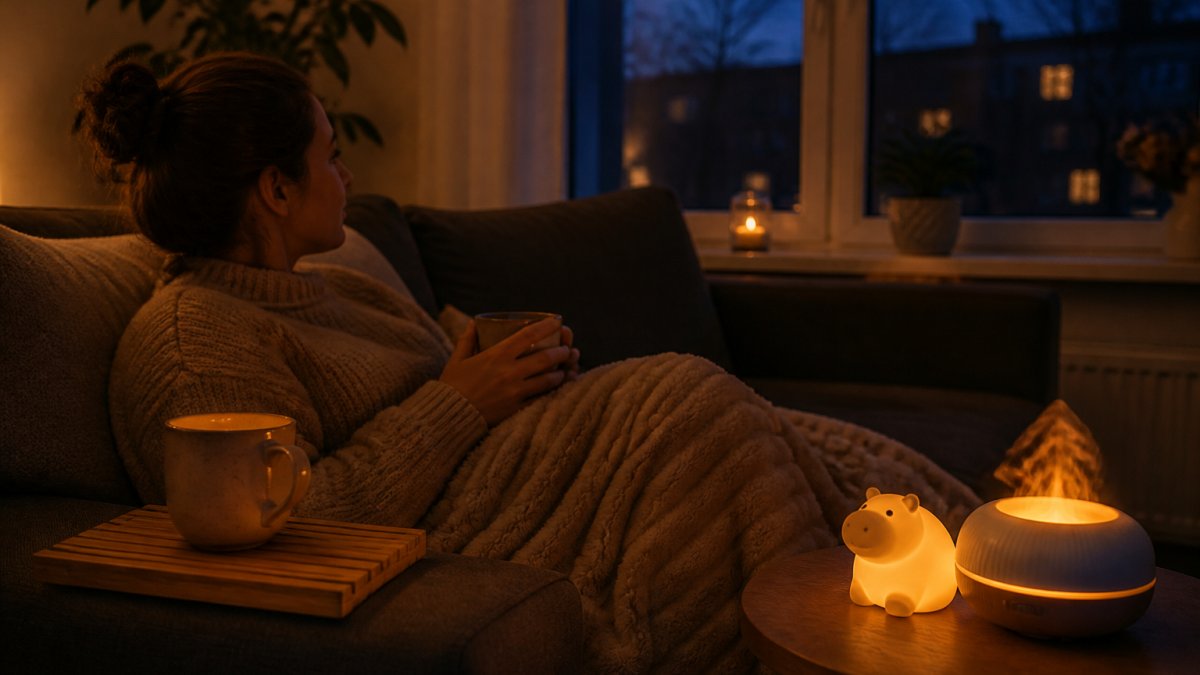
Our Cozy Flame Aromatherapy Diffuser & Air Humidifier can run during that last hour: a flame-like LED glow, ultrasonic mist for essential oils, a 1, 3, or 5-hour timer, and auto shut-off when the water runs out.

Slow Living Tips When Your Schedule Is Genuinely Full
Slow living tips still apply when your schedule is genuinely full, but they have to be measured in minutes rather than hours. A parent working full-time with two children and a commute does not have a slow morning. They have a seven-minute window. The practice is to protect that window instead of mourning the one you do not have.
Three approaches that survive a packed week:
- Protect transitions, not blocks. You will not find a free hour. You can find the ninety seconds between the car and the front door.
- Batch the decisions. Same breakfast, same clothes rotation, same weekly meal pattern. Decision fatigue is a bigger drain than the tasks themselves.
- Make rest physical. Sitting down with a drink within reach is rest. Standing in the kitchen holding a mug is not.
That second point about physical rest is where small furniture changes pay off. Our Natural Bamboo And Wood-colored Lazy Sofa Armrest Tray sits on a sofa arm with no tools and offers a built-in cup holder and a phone slot and remote tray to keep essentials within reach.

What to Ignore in the Slow Living Advice You See Online
Ignore any slow living advice that requires buying a new identity before it works. The internet's version of slow living has drifted toward an aesthetic: linen, ceramics, a specific kind of morning. That version is expensive, photogenic, and largely unrelated to feeling calmer.
Three things to skip:
- The full-day reset. A single perfect Sunday does not undo a stressful month. Small daily repetitions do more.
- Buying your way in. More objects will not slow your life down. A few well-chosen ones that remove friction or prompt a pause can help. The distinction is whether the item does a job.
- Rigid routines. Any routine that collapses the moment a child gets sick was never a routine. Build in slack from the start.
If you want a grounded way to tell the difference between a tool that helps and a tool that decorates, our guide on how to choose stress relief tools for home workers walks through the questions worth asking before you buy anything. It applies to parents just as well.
One honest caveat about our own catalog: not everything we sell is a stress tool. Some of it is just pleasant. That is fine, as long as you know which is which.
Building Your Slow Living Starter Kit at GreatLazy
A slow living starter kit should contain three things at most, and each one should either remove friction or prompt a pause. Anything that does neither is decoration.
Here is how we would build it for a stressed parent:
| Purpose | What it does | Where it fits |
|---|---|---|
| Visual anchor | Gives your eyes somewhere slow to rest | Desk, kitchen shelf, bedside |
| Evening signal | Marks the shift from active to winding down | Bedroom, living room side table |
| Physical rest enabler | Keeps what you need within reach so you stay seated | Sofa arm |
Frequently Asked Questions
What does slow living mean for parents?
Slow living for parents means deliberately reducing the pace and volume of daily demands so there is room to notice your children and yourself. In practice it looks like fewer scheduled activities, predictable routines, and single-tasking instead of juggling. It is not about quitting work or moving to the countryside. Most parents start with one change, such as a screen-free bedtime or a slower morning, and build from there. The goal is a calmer household rhythm you can actually sustain, not a perfect lifestyle.
How can stressed parents start living more slowly?
Pick one anchor habit and repeat it for two weeks before adding anything else. Good first choices are a ten-minute wind-down before bed, eating one meal a day without phones, or a short walk after school pickup. Pair the habit with something you already do so it sticks. Slow living tips only work when they fit your real schedule, so start smaller than feels impressive. Once the first habit feels automatic, add a second.
How do you slow down when you have young children?
With young children, slow living usually means simplifying routines rather than adding quiet time you will not get. Build predictable bookends to the day, morning and bedtime, and keep them short. Reduce the number of transitions in a day, since each one tends to trigger friction. Prepare what you can the night before. A dim, warm light in the bedroom helps signal wind-down without a battle, and a soft touch lamp children can tap themselves gives them a sense of control over bedtime.
Can slow parenting work with a busy schedule?
Yes, because slow parenting is about the quality and pace of the moments you already have, not extra hours in the day. A five-minute bedtime chat with no phone in reach counts. So does walking to school instead of driving when the weather allows. The trick is protecting a few small windows rather than trying to slow down the entire day. Parents who try to overhaul everything at once usually abandon it within a week.
What should you do when slow living still feels stressful?
If slowing down feels like another task to manage, cut your plan in half. Choose one routine and drop the rest for now. It also helps to check whether you are chasing an aesthetic rather than a feeling: the goal is a calmer household, not a perfectly styled one. If stress stays high for weeks and affects sleep or mood, speak to your doctor. Slow living tips support wellbeing but they are not a substitute for professional support.
How can parents make more time for family connection?
Connection grows in small, repeated moments more than in big planned events. Try a two-minute check-in at dinner where everyone shares one good thing from the day, or a shared tidy-up before bed. Family connection activities do not need equipment or a schedule. Keep a short list of options you can pull out when there is a spare ten minutes, such as a card game, a kitchen dance, or flipping a moving sand art frame together and watching it settle.
The real challenge is not learning about slow living. It is holding onto one small pause on the days when everything is on fire. GreatLazy exists to make those pauses easier to reach: free shipping on every order, a curated selection of easy-to-use home goods, and a focus on items that support rest rather than add another job to your list. Customers rate us 4.6/5 across 206 reviews. Get started with GreatLazy and build a starter kit that earns its place in your home.
